
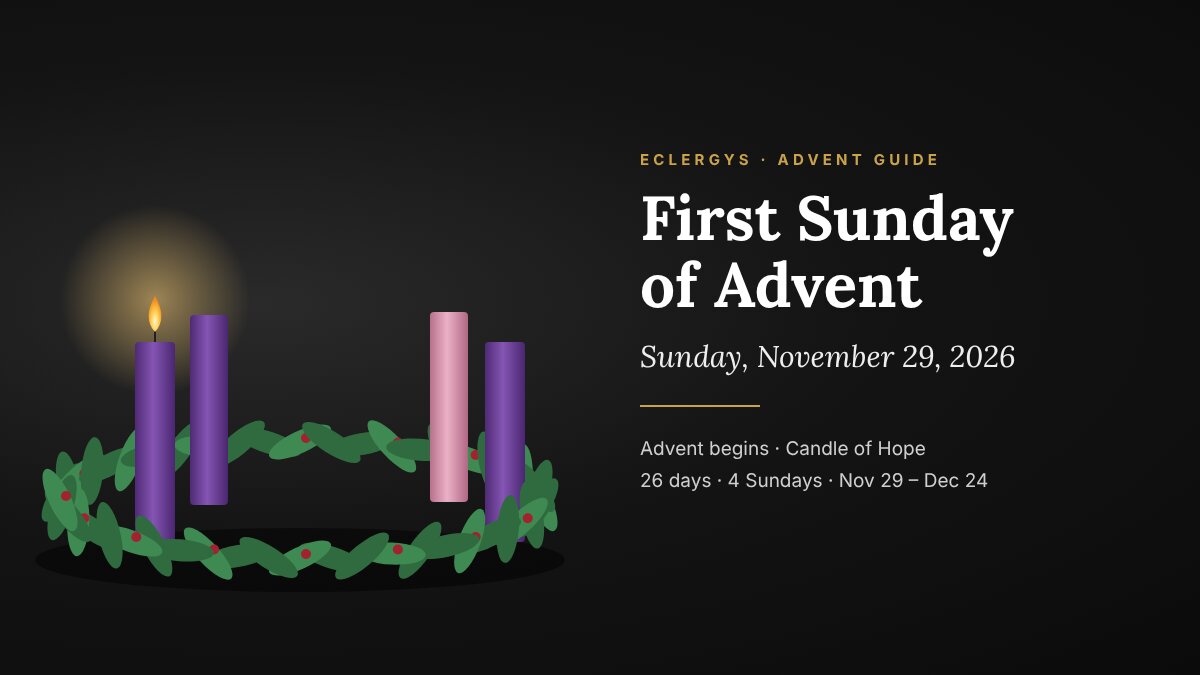
First Sunday of Advent 2026: When Advent Starts and What It Means
A single purple candle, a circle of evergreen, and a priest in violet vestments. For many Christians, that quiet scene is how the Church year begins. It happens on the first Sunday of Advent, and in 2026 it arrives on Sunday, November 29, just three days after Thanksgiving.
Yet every autumn the same questions come back. When is Advent this year? How long is Advent? Why does the start date keep moving? And what exactly are we supposed to be doing on that first Sunday?
This article answers all of it in plain language. You will learn the Advent 2026 dates, how many days and Sundays the season holds, how the first Sunday of Advent is worked out, what the first candle of hope means, which Scripture readings are proclaimed, and why clergy change into violet as the season opens.
When Does Advent Start in 2026?
Advent starts on Sunday, November 29, 2026. That date is the first day of Advent, the first Sunday of Advent and New Year's Day of the Church calendar, all rolled into one.
The season then runs through Thursday, December 24, Christmas Eve. Once the Christmas Eve vigil begins that evening, Advent is over and the twelve days of Christmas take its place.
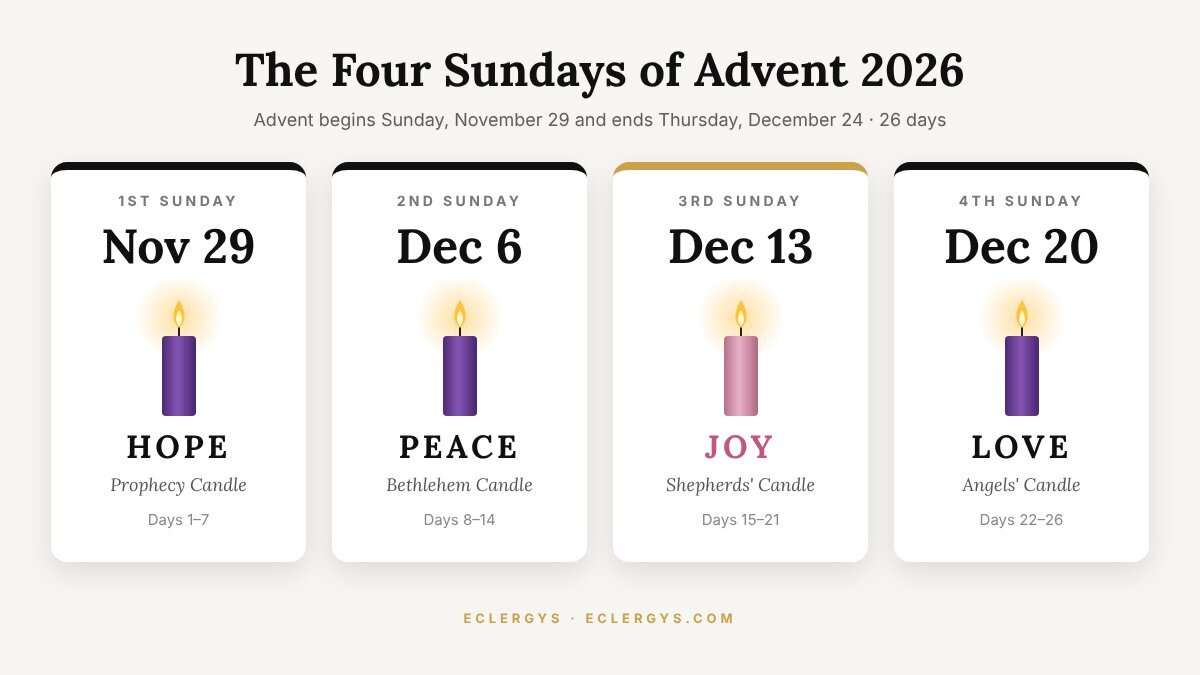
These are the four Advent Sundays of 2026:
- First Sunday of Advent: November 29 (Hope)
- Second Sunday of Advent: December 6 (Peace)
- Third Sunday of Advent, Gaudete Sunday: December 13 (Joy)
- Fourth Sunday of Advent: December 20 (Love), the last Sunday before Christmas
Catholic Advent 2026 starts on the same day as Advent in Anglican, Episcopal, Lutheran, Methodist and Presbyterian churches. The date also matches in the United States, the United Kingdom, Canada and Australia. German-speaking churches call the day Erster Advent; it is the same Sunday.
If you remember seeing November 30 listed somewhere, that was Advent in 2025. This year the season opens one day earlier.
How Many Days and Weeks Are in Advent?
There are 26 days in Advent 2026. Count from November 29 to December 24 and you land on that number.
The length is different every year because Christmas moves through the week while Advent always keeps exactly four Sundays. When Christmas lands on a Monday, the season shrinks to 22 days. When it lands on a Sunday, it stretches to a full 28. Christmas 2026 is a Friday, so the fourth week of Advent lasts only five days, from Sunday, December 20, to Thursday, December 24.
That is why people talk about the four weeks of Advent even though the last week is rarely complete. A quick summary for 2026:
- Advent length: 26 days
- Number of Advent Sundays: 4
- Weeks of Advent: 3 full weeks plus a short fourth week
What day of Advent is it today? Treat November 29 as Day 1. In December, simply add two to the calendar date: December 5 is Day 7, December 15 is Day 17, and December 24 is Day 26. Week one runs November 29 to December 5, week two December 6 to 12, week three December 13 to 19, and week four December 20 to 24.
Counting down? From the first of November there are 28 days until Advent begins.
How Is the First Sunday of Advent Decided?
The first Sunday of Advent is always the fourth Sunday before Christmas. Older prayer books describe it a little differently: Advent Sunday is the Sunday nearest to November 30, the feast of St. Andrew. Either way, you get the same date.
Because of this rule, Advent can begin no earlier than November 27 and no later than December 3. It is never connected to the first Sunday of November or to the first Sunday of the calendar year.
The Sunday readings also run on a three-year cycle, called Year A, Year B and Year C. Here is how the first Sunday of Advent has fallen in recent years and when it comes next:
|
Year |
First Sunday of Advent |
Reading cycle |
|
2027 |
November 28 |
C (Luke) |
|
2026 |
November 29 |
B (Mark) |
|
2025 |
November 30 |
A (Matthew) |
|
2024 |
December 1 |
C |
|
2023 |
December 3 |
B |
|
2022 |
November 27 |
A |
|
2021 |
November 28 |
C |
|
2020 |
November 29 |
B |
|
2019 |
December 1 |
A |
|
2018 |
December 2 |
C |
|
2017 |
December 3 |
B |
|
2016 |
November 27 |
A |
|
2015 |
November 29 |
C |
|
2014 |
November 30 |
B |
What Does the First Sunday of Advent Mean?
The first Sunday of Advent is about hope, and more specifically about hope that stays awake. Advent takes its name from the Latin adventus, "arrival." Christians spend these weeks remembering one arrival and expecting another: the birth of Jesus in Bethlehem, and his return in glory at the end of history.
It surprises many people that the first Sunday is not really about the manger at all. The Gospel that day speaks of the Son of Man coming suddenly, of servants who must not be caught sleeping, and of a doorkeeper told to keep watch through the night. Christmas is still almost a month away. The Church first asks a harder question: if Christ came today, would we be ready?
That is where hope comes in. Biblical hope is not wishful thinking. It is trust that God will finish what he has started, the same trust that carried Israel through long centuries of waiting for the Messiah.
The day goes by a few different names:
- Advent Sunday, used widely in Britain and in Anglican churches
- Hope Sunday, named after its candle
- Ad Te Levavi, from the first words of the old Latin entrance chant from Psalm 25, "To you, O Lord, I lift up my soul"
The first Sunday of Advent matters because it turns the page. Ordinary Time ends with Christ the King on November 22, and a new year of prayer, readings and feasts begins the following week.
The First Advent Candle and the Advent Wreath
On the first Sunday of Advent, one purple candle is lit on the Advent wreath. This is the candle of hope, traditionally known as the Prophecy Candle. It recalls the prophets, Isaiah above all, who promised that a Saviour would come.
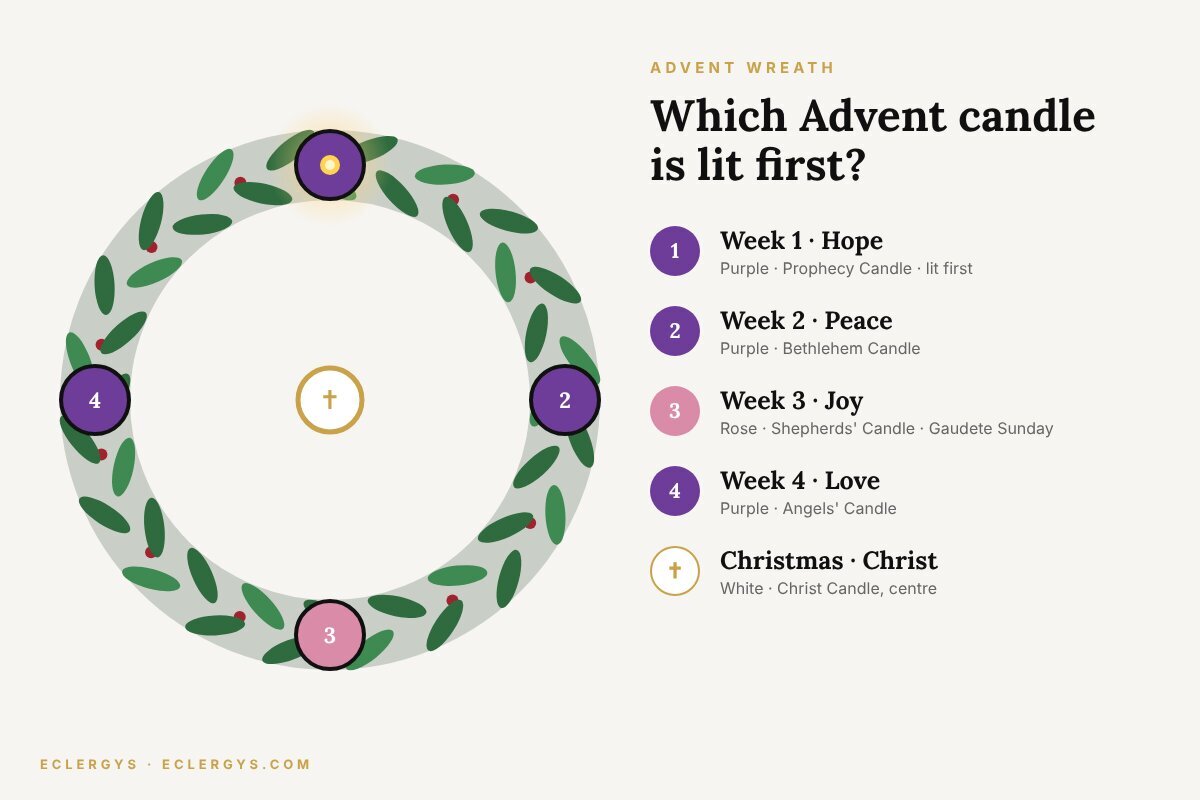
The wreath itself is full of meaning. Its circular shape has no beginning or end, a picture of God's eternal love. The evergreen branches stay alive through winter, pointing to the life Christ brings. On it stand four candles: three purple and one rose. Many churches also place a white Christ Candle in the middle, lit at Christmas.
One new candle is added each Sunday:
- Week one: purple, the Prophecy Candle, for hope
- Week two: purple, the Bethlehem Candle, for peace (some churches say faith)
- Week three: rose, the Shepherds' Candle, for joy on Gaudete Sunday
- Week four: purple, the Angels' Candle, for love
- Christmas: white, the Christ Candle
So which Advent candle is lit first? Always a purple one. The rose candle waits for the third Sunday, when the mood lifts because Christmas is close.
What does the first Advent candle symbolize? Think of one flame in a dark room. It does not light everything, but it is enough to see by, and it promises more light to come. Each week the wreath grows a little brighter, until the Christ Candle shines in the centre on Christmas.
Some Protestant congregations use blue candles in place of purple. Blue carries the same message of hopeful waiting, so either colour is a faithful choice.
Scripture Readings for the First Sunday of Advent 2026
Advent 2026 opens Year B, the year when most Sunday Gospels come from St. Mark. Catholic parishes and churches that follow the Revised Common Lectionary hear nearly the same passages:
- First reading: Isaiah 63:16b–17, 19b; 64:2–7 at Catholic Mass, or Isaiah 64:1–9 in the Revised Common Lectionary
- Responsorial psalm: Psalm 80, a prayer asking God to restore his people and let his face shine on them
- Second reading: 1 Corinthians 1:3–9
- Gospel: Mark 13:33–37 at Catholic Mass, or the longer Mark 13:24–37
Read together, these passages trace a clear line. Isaiah gives voice to a people who feel God is distant and beg him to break into their world. The psalm turns that longing into a refrain of prayer. St. Paul reassures the Christians of Corinth that God is faithful and has already given them every gift they need while they wait. Then Jesus closes with a one-word command for every disciple: watch.
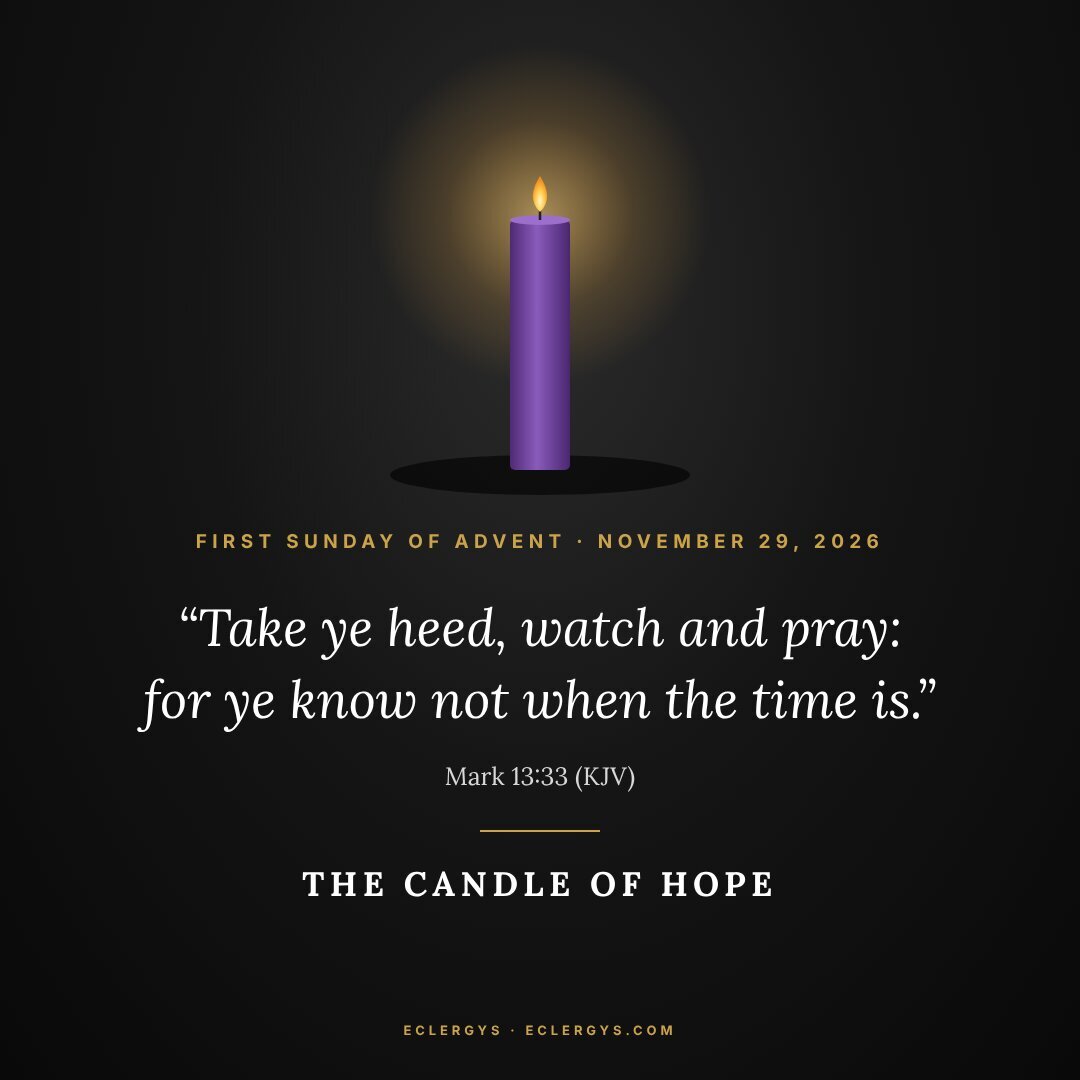
In the King James Version, Mark 13:33 reads, "Take ye heed, watch and pray: for ye know not when the time is." It is a fitting motto for the whole season.
Looking ahead or back? In Year A (2025) the Gospel is Matthew 24:37–44, and in Year C (2027) it is Luke 21:25–28, 34–36.
Prayers, Hymns and Ways to Keep the First Sunday of Advent
A simple prayer for the first week of Advent
You can pray this as you light the first candle, at the start of a parish meeting, or at the dinner table each evening of the first week:
Faithful God, as this first candle burns, fill us with the hope that does not disappoint. Keep us awake to your presence in ordinary days, patient in waiting and ready to welcome your Son. Come, Lord Jesus. Amen.
At Catholic Mass, the priest prays the Collect for the First Sunday of Advent from the Roman Missal, asking that we hurry to meet Christ with good works. Anglican and Episcopal churches pray the classic Advent collect from the Book of Common Prayer, which asks God for grace to "cast away the works of darkness."
Hymns that fit the day
Save the Christmas carols for Christmas if you can. Advent has its own music, full of longing:
- O Come, O Come, Emmanuel
- Come, Thou Long-Expected Jesus
- Creator of the Stars of Night
- Lo, He Comes with Clouds Descending
- Wake, Awake, for Night Is Flying
Ideas for families and parishes
- Bless an Advent wreath at home and light the first candle together after Mass or Sunday service.
- Read one short passage each night, perhaps from Isaiah, and talk about what it means to wait well.
- Start a Jesse Tree with the children, adding one Bible story ornament a day.
- Choose a small Advent practice for the whole family: a donation jar, an evening without screens, or a visit to someone who lives alone.
- For a sermon or homily, Mark's image of the watchful doorkeeper makes a strong starting point for a message on hope.
Good verses on hope for Advent devotionals include Isaiah 9:2, Isaiah 40:31, Jeremiah 33:14–16, Romans 15:13 and Titus 2:13.
How Many Days Are on an Advent Calendar?
A typical Advent calendar has 24 doors, covering December 1 through December 24. A few include a 25th door for Christmas morning.
That means the calendar on your fridge and the Church's Advent season rarely line up. In 2026 the season starts on November 29 and lasts 26 days, so by the time you open door number one on December 1, you are already on Day 3 of Advent.
When to start your Advent calendar in 2026:
- Regular 24-door calendar: December 1
- Liturgical calendar that follows the Church season: November 29
- Countdown calendar numbered backward: December 1, starting with the highest number
The custom grew out of 19th-century Germany, where families counted the days of December with chalk marks or a candle a day. Printed calendars with little paper doors followed in the early 1900s. For a calendar that keeps Christ at the centre, look for one with a Bible verse or short prayer behind each door.
How Did Advent Begin?
Advent was first observed in the late fourth and fifth centuries, in what is now Spain and France. Those early Christians kept a season of fasting and prayer before Epiphany, when new converts were often baptised. In Tours, Bishop Perpetuus set a fast that began on St. Martin's Day, November 11, giving the season the nickname "St. Martin's Lent."
Rome shaped the season differently. By the time of Pope Gregory the Great in the sixth century, Advent had settled into the four Sundays the Western Church keeps today. Over the Middle Ages it took on its twofold focus, preparing both for Christmas and for Christ's second coming.
The Advent wreath is far younger. It is usually credited to Johann Hinrich Wichern, a Lutheran pastor in Hamburg, who in 1839 hung candles on a wooden cartwheel to help the children in his care count down to Christmas. The simpler four-candle evergreen wreath grew from his idea.
Not every church keeps the same length. The Ambrosian Rite of Milan observes six weeks of Advent, and Eastern Orthodox Christians keep a 40-day Nativity Fast starting on November 15.
The Role of Vestments in Advent
When the congregation walks into church on the first Sunday of Advent, the change is visible before a word is spoken. The green of Ordinary Time is gone. The altar, the pulpit and the clergy are now dressed in violet.
Violet is the colour of waiting, repentance and royal dignity. It tells the faithful that the King is on his way and that hearts need preparing. In many Lutheran, Methodist and some Anglican churches, blue is used instead, a colour linked to hope and to the night sky before dawn.
The colours shift during the season:
- First, second and fourth Sundays: violet or blue
- Third Sunday (Gaudete): rose, a softer colour of joy
- Christmas: white or gold
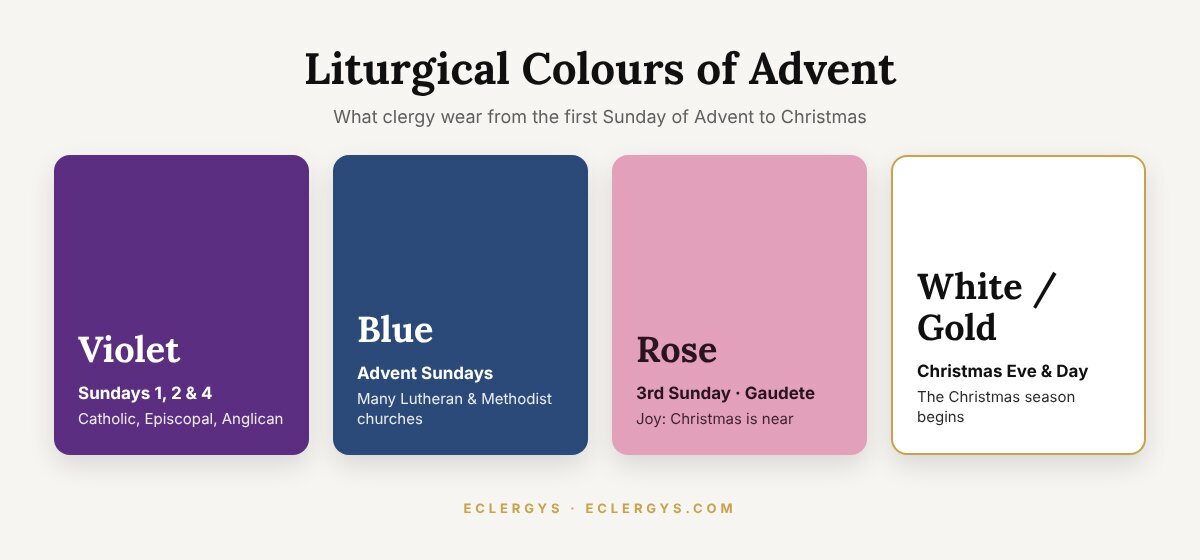
For a Catholic priest, that usually means a violet chasuble and stole over the alb, held by a cincture. Deacons wear a violet stole or dalmatic. Protestant pastors often wear a black pulpit robe or a cassock with a violet or blue stole. Bishops may add violet to their cassock trim and zucchetto. Altar servers keep their cassocks and surplices ready for a full calendar of Advent Masses, penance services and Christmas Eve.
Congregants have no colour rule. Wearing purple or navy on the first Sunday of Advent is a nice way to join in, but your usual Sunday best is perfectly fitting.
If your church is preparing for the season, eClergys offers everything clergy and servers need for Advent and Christmas:
- Clergy stoles and tippets in violet, blue, rose and white
- Vestments for priests, deacons and ministers
- Clergy cassocks, including Roman purple and red purple for bishops and monsignors
- Clergy robes and cassocks for men for pulpit and choir
- Clergy cinctures to complete the alb
- Clergy shirts for men and clergy shirts for women for everyday ministry through the season
- Altar server cassocks, albs and surplices
Ordering in October or early November leaves time for sizing and delivery before November 29.
Frequently Asked Questions (FAQs)
- What is the date of the first Sunday of Advent 2026?
The first Sunday of Advent 2026 is Sunday, November 29. It marks the first day of Advent and the beginning of the new Church year.
- When does Advent end in 2026?
Advent ends on Thursday, December 24, 2026. The Christmas season begins with the vigil on Christmas Eve.
- How many Sundays are in Advent?
Advent always has four Sundays. In 2026 they are November 29, December 6, December 13 and December 20.
- What is the theme of the first Sunday of Advent?
The theme is hope. The Scripture readings call believers to stay awake and ready for Christ's coming, and the first purple candle on the Advent wreath is lit as a sign of that hope.
- Is the first Sunday of Advent the same for Catholics and Protestants?
Yes. Catholic, Anglican, Episcopal, Lutheran and Methodist churches all mark the first Sunday of Advent on November 29, 2026.
- What colour do priests wear on the first Sunday of Advent?
Priests and pastors wear violet, the liturgical colour of Advent. Some Protestant churches use blue, and the third Sunday switches to rose.
Conclusion:
Advent 2026 begins on Sunday, November 29, and gives the Church 26 days to prepare for Christmas. The first Sunday sets the tone with a single candle of hope and a simple command from the Gospel: watch. Whether you are lighting a wreath at home, planning a homily, or preparing the sanctuary, it is a day to slow down, look up and get ready to welcome Christ. From violet stoles to altar server surplices, eClergys is here to help your church dress the season with reverence.