

The Joy of Gaudete Sunday: What Is the Third Week of Advent?
For two Sundays, the Advent wreath has glowed with violet candles. The readings have spoken about waking up, getting ready, and turning back to God. Then the third Sunday arrives, and something changes. A rose-colored candle is lit. In many churches, the priest walks out in rose vestments instead of violet. The first words of the Mass are not a call to repent, but a command: Rejoice!
This is the third week of Advent. It is short, it is bright, and it carries one of the most important messages of the whole season. Here is what it means, where its traditions come from, and how churches, clergy, and families can keep it well.
Quick answer: The third week of Advent begins on the Third Sunday of Advent, known as Gaudete Sunday. Gaudete (say "gow-DAY-tay") is Latin for "rejoice." The name comes from the opening words of the Sunday's Mass, taken from Philippians 4:4–5: "Rejoice in the Lord always… The Lord is near." The theme of the week is joy, because Christmas is close and Christ's coming is near. Many churches light a rose (pink) candle on the Advent wreath, and clergy may wear rose vestments. In 2026, Gaudete Sunday falls on December 13, and the third week runs from December 13 to December 19.
What Is the Third Week of Advent?
Advent is the season of four Sundays that prepares Christians for Christmas. The word comes from the Latin adventus, meaning "coming." Advent looks in two directions at once. It prepares us to celebrate Christ's first coming at Bethlehem, and it reminds us to be ready for his second coming at the end of time.
The third week builds on what came before. The First Sunday of Advent opens the season with a call to stay awake and hope, and the Second Sunday of Advent brings John the Baptist's call to prepare the way of the Lord. Gaudete Sunday is where that preparation turns to joy.
Advent dates for 2026 and 2027
Advent dates |
Advent 2026 (Lectionary Year B) |
Advent 2027 (Lectionary Year C) |
|
First Sunday of Advent |
November 29, 2026 |
November 28, 2027 |
|
Second Sunday of Advent |
December 6, 2026 |
December 5, 2027 |
|
Third Sunday (Gaudete) |
December 13, 2026 |
December 12, 2027 |
|
Third week of Advent |
December 13–19, 2026 |
December 12–18, 2027 |
|
Fourth Sunday of Advent |
December 20, 2026 |
December 19, 2027 |
|
Christmas Day |
Friday, December 25, 2026 |
Saturday, December 25, 2027 |
In 2026, Gaudete Sunday falls on December 13, the day usually kept as the memorial of Saint Lucy. Because it is a Sunday of Advent, the Sunday takes priority in the Catholic calendar that year.
Why Is the Third Sunday of Advent Called Gaudete Sunday?
Some Sundays of the Church year are named after the first Latin word of the chant sung at the start of Mass, called the Introit or Entrance Antiphon. The third Sunday of Advent opens with these words:
Gaudete in Domino semper: iterum dico, gaudete… Dominus prope est.
In English: "Rejoice in the Lord always; again I say, rejoice… The Lord is near." These words come from Saint Paul's letter to the Philippians (4:4–5). That first word, Gaudete, gave the day its name.
The grammar is worth noticing. Gaudete is a plural command. It is not a gentle suggestion to one person who happens to feel cheerful. It is an instruction to the whole community: all of you, rejoice. And Paul gives the reason in the same breath: the Lord is near.
Today the Roman Missal officially calls the day the Third Sunday of Advent, but the same entrance antiphon is still used, so the traditional name Gaudete Sunday remains in wide use among Catholics, Anglicans, Lutherans, and others.
The Spiritual Meaning of Joy in Advent
If Advent is a season of waiting and repentance, why stop in the middle to rejoice? The answer says a lot about what Christians mean by joy.
Joy is not the same as happiness
Happiness usually depends on what is happening around us. Joy, in the Christian sense, rests on who God is and what he has promised. That is why Paul could tell the Philippians to rejoice while he himself was in chains (Philippians 1:13). His joy did not come from comfortable circumstances. It came from knowing that the Lord was near.
This matters in December. For many people the weeks before Christmas are busy, expensive, and sometimes lonely. Gaudete Sunday does not ask anyone to pretend that life is easy. It asks believers to lift their eyes. In his 2014 Gaudete Sunday homily, Pope Francis called it the "Sunday of joy" and encouraged people to think less about what they have not yet finished before Christmas and more about the good things God has given them.
Joy that comes from God's nearness
The readings of this Sunday give joy a clear source. The prophet Zephaniah tells Jerusalem to shout for joy because "the Lord, your God, is in your midst" (Zephaniah 3:17). Isaiah describes the desert bursting into bloom when God comes to save his people (Isaiah 35:1–2). Mary sings, "My spirit rejoices in God my Savior" (Luke 1:47). In every case, joy comes from the same place: God is coming close.
Joy that shows up in how we live
John the Baptist appears on both the second and third Sundays of Advent. When the crowds ask him, "What should we do?" he gives plain answers: share your extra coat, share your food, be honest at work, do not cheat or bully anyone (Luke 3:10–14). Christian joy is not only a feeling. It overflows into generosity, honesty, and kindness. Joy that stays locked inside is not yet the joy Gaudete Sunday is talking about.
What Does the Pink (Rose) Advent Candle Represent?
Most Catholic and many Protestant Advent wreaths hold three violet candles and one rose candle. The rose candle is lit on the third Sunday, together with the two violet candles from the first two weeks.
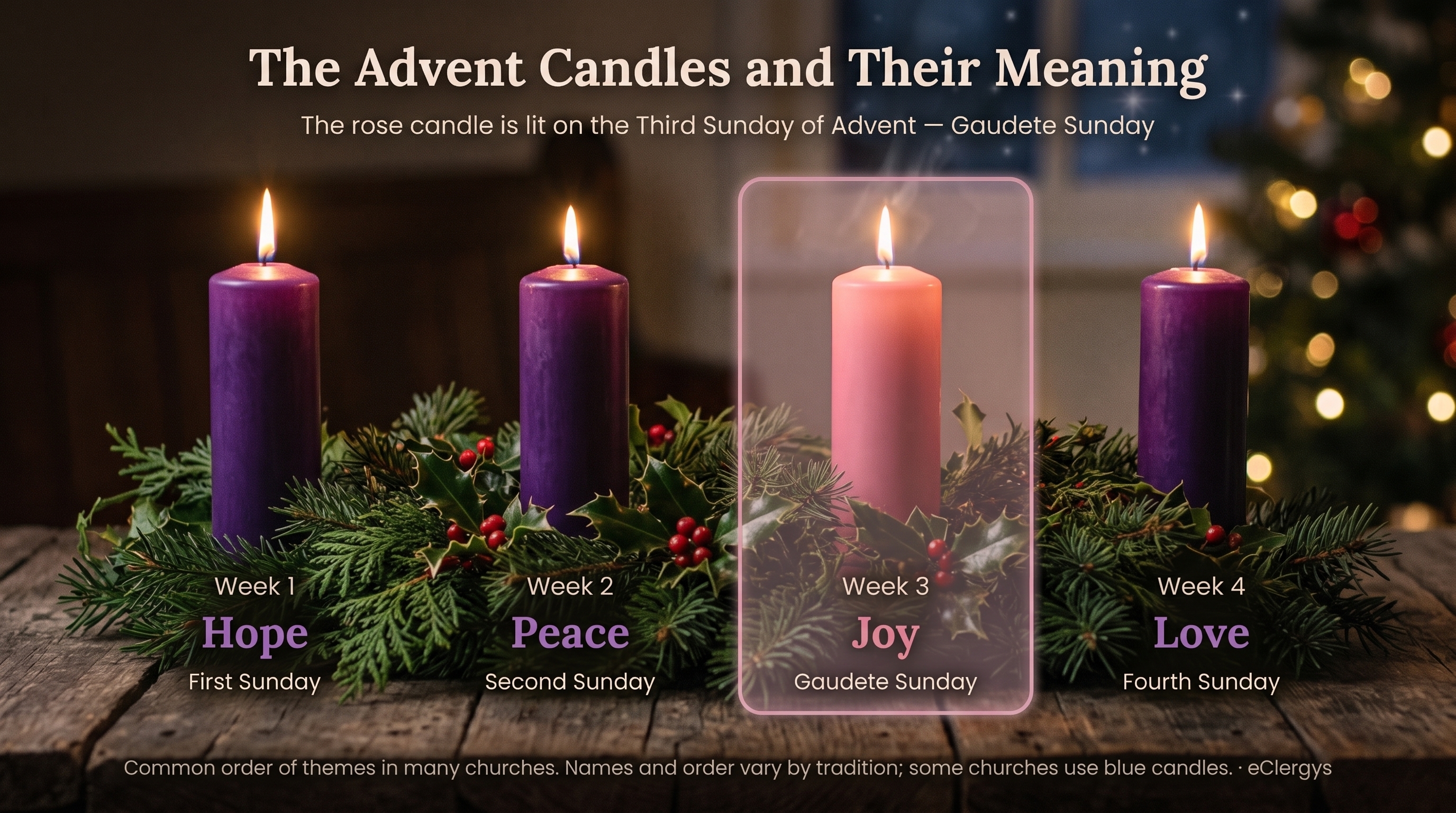
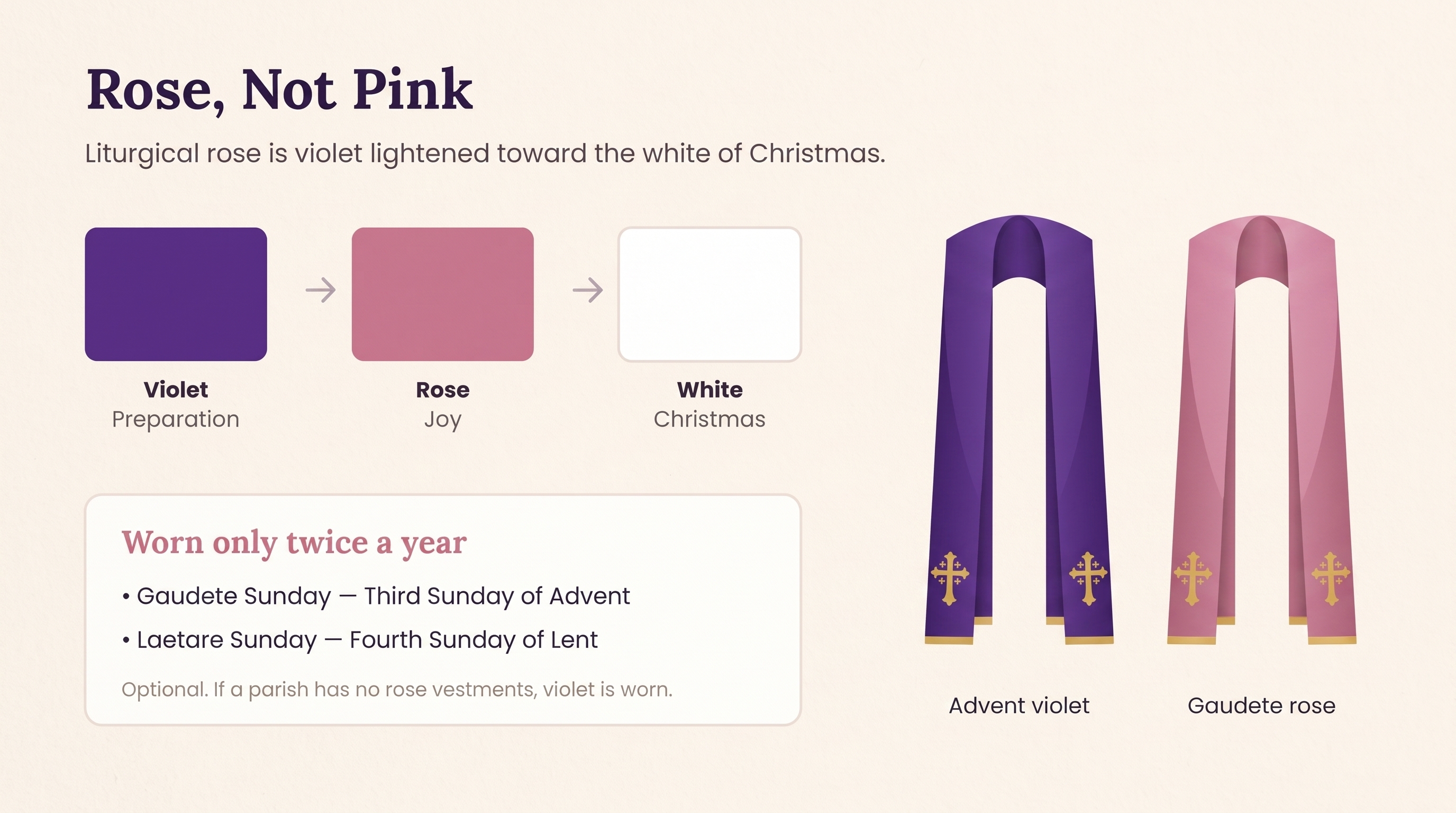
The rose candle represents joy. It matches the rose color that clergy may wear on Gaudete Sunday. The color itself carries a message. Violet is the color of preparation and penance. Rose is a softer, lighter version of violet, as if the dark color of waiting has started to brighten with the light of Christmas.
Is it pink or rose?
Liturgical books call the color rose, not pink. In everyday speech, most people say "the pink candle," and that is fine. But when clergy talk about vestments, "rose" is the correct term. In practice, rose vestments range from a dusty, muted rose to a brighter pink, depending on the fabric and the maker.
Why is it called the Shepherd's Candle?
In many Protestant churches, each Advent candle has a name. The third is often called the Shepherd's Candle, recalling the shepherds near Bethlehem who heard the angel announce "good news of great joy" (Luke 2:10). This naming is a popular devotional custom. It is not part of the official Catholic liturgy, and it varies from church to church.
Not every wreath has a pink candle
Some Lutheran, Methodist, and other Protestant churches use blue for Advent, the color of hope and expectation. Their wreaths may have four blue candles, so there is no pink candle at all. The order of themes also varies. Many churches use hope, peace, joy, and love, while others use a different order or different themes. What stays almost constant is this: joy belongs to the third Sunday.
The History of Gaudete Sunday
For many centuries, Advent in the Western Church was kept as a season of fasting and penance, much like a shorter Lent. Because of that, it was given a pause in the middle, just as Lent has one.
Lent's midpoint is the Fourth Sunday of Lent, called Laetare Sunday, from another Latin word meaning "rejoice." Gaudete Sunday became its Advent counterpart. On both days, the Church relaxed the strict tone of the season. According to the older Catholic Encyclopedia, on Gaudete Sunday the organ and flowers, normally avoided during Advent, were allowed, and rose vestments could be worn instead of violet. Its point was the same then as now: to signal that the Lord's coming is near.
The use of rose is often connected to an old papal custom on Laetare Sunday, when the Pope blessed a "Golden Rose." Historians describe this link in different ways, so it is best understood as part of the background of rose vestments rather than a single, proven origin.
The Advent wreath is much younger than Gaudete Sunday. The popular wreath with candles developed in 19th-century Germany. Its single rose candle was added to match the rose vestments already worn on the third Sunday. That is why the candle is lit on the third Sunday and not the fourth: it follows the liturgy.
Today, the Catholic Church's General Instruction of the Roman Missal (no. 346) says that rose may be used, where it is the practice, on Gaudete Sunday and Laetare Sunday. In the Church of England, the use of rose, once informal, is now noted as an option in Common Worship.
Bible Readings for the Third Sunday of Advent
Catholic Sunday readings follow a three-year cycle (Years A, B, and C). Many Protestant churches use the Revised Common Lectionary, which follows a similar pattern with small differences in verses.
|
Lectionary year |
Years it falls in |
First Reading |
Psalm / Response |
Second Reading |
Gospel |
|
Year A |
2025, 2028 |
Isaiah 35:1–6a, 10 |
Psalm 146 |
James 5:7–10 |
Matthew 11:2–11 |
|
Year B |
2026, 2029 |
Isaiah 61:1–2a, 10–11 |
Luke 1:46–50, 53–54 (the Magnificat) |
1 Thessalonians 5:16–24 |
John 1:6–8, 19–28 |
|
Year C |
2027, 2030 |
Zephaniah 3:14–18a |
Isaiah 12:2–6 |
Philippians 4:4–7 |
Luke 3:10–18 |
Readings shown follow the Catholic Lectionary for Mass (USA). The Revised Common Lectionary uses slightly different verse ranges, for example Isaiah 61:1–4, 8–11 and Psalm 126 in Year B.
What the readings teach
Year A pairs Isaiah's picture of the blind seeing and the lame leaping with the Gospel where John the Baptist, in prison, asks Jesus, "Are you the one who is to come?" Jesus answers by pointing to those very signs. James adds a word about patience, like a farmer waiting for the harvest.
Year B, used in 2026, opens with Isaiah 61, "The spirit of the Lord God is upon me," the same passage Jesus later reads in the synagogue at Nazareth (Luke 4:18). Instead of a psalm, the response is Mary's song of praise. Paul tells the Thessalonians, "Rejoice always" (1 Thessalonians 5:16). In the Gospel, John the Baptist says he is not the light, only a witness to the light.
Year C contains the passage that gave Gaudete Sunday its name, Philippians 4:4–7, paired with Zephaniah's call to "shout for joy." In the Gospel, John tells ordinary people how to prepare: share, be fair, and be honest.
More Bible verses about Advent joy
- "Rejoice in the Lord always; again I will say, Rejoice." (Philippians 4:4)
- "The Lord, your God, is in your midst." (Zephaniah 3:17)
- "My spirit rejoices in God my Savior." (Luke 1:47)
- "I am bringing you good news of great joy for all the people." (Luke 2:10)
- "The joy of the Lord is your strength." (Nehemiah 8:10)
- "The Lord has done great things for us, and we rejoiced." (Psalm 126:3)
- "May the God of hope fill you with all joy and peace in believing." (Romans 15:13)
How Churches Celebrate the Third Sunday of Advent
Gaudete Sunday is mainly a Western Christian observance. Here is how different traditions usually keep it. Practices vary by parish, so local custom always comes first.
|
Tradition |
Liturgical color |
Advent wreath |
Typical customs |
|
Roman Catholic |
Rose may be worn; violet if no rose vestments |
3 violet + 1 rose; rose lit on 3rd Sunday |
Entrance antiphon "Gaudete"; flowers may return to the sanctuary; blessing of Christ Child figures (Bambinelli) in some parishes |
|
Anglican / Episcopal |
Violet or blue; rose is an option (e.g., Church of England Common Worship) |
Varies: violet with rose, or all blue |
Joyful hymns; readings about John the Baptist and rejoicing |
|
Lutheran |
Blue or violet; some use rose |
Often 4 blue candles, or 3 violet + 1 rose |
Traditional name "Gaudete" still known; theme of joy |
|
Methodist and other Protestant |
Purple or blue (United Methodist Book of Worship allows both) |
Often hope, peace, joy, love; third candle may be pink |
"Joy" Sunday; Shepherd's Candle readings; children's Advent lessons |
|
Eastern Orthodox |
No Gaudete Sunday |
Wreath is not a traditional Orthodox practice |
Keeps the 40-day Nativity Fast instead |
Bambinelli Sunday
In Rome, the third Sunday of Advent is also known as Bambinelli Sunday. Children bring the baby Jesus figures from their home nativity scenes to Saint Peter's Square, and the Pope blesses them after the Sunday Angelus prayer. According to Vatican News, the custom goes back to Saint Paul VI and has continued under later popes. Many parishes around the world now invite families to bring their Christ Child figures to Mass on Gaudete Sunday for a blessing.
How Pastors and Clergy Prepare for Gaudete Sunday
For clergy, Gaudete Sunday is one of only two days a year when rose vestments may appear. That makes it easy to overlook in planning. A little preparation helps the day speak clearly.
1. Confirm the color and local practice
In the Catholic Church, rose is permitted, not required. The rubrics say rose may be used "where it is the practice." If a parish does not own rose vestments, violet is the correct color to wear. Anglican, Lutheran, and Methodist clergy should follow their own church's liturgical calendar and local custom, which may call for violet, blue, or rose.
2. Check vestments early
Vestments worn only once or twice a year often spend months folded in a drawer. Take them out in early December. Look for fading, creases, loose threads, or stains, and allow time for pressing or repair. Match stoles, chasubles, and any altar paraments so the colors work together under your church's lighting.
3. Prepare the whole sanctuary, not just the priest
Gaudete Sunday is a visible change for the whole congregation. Check that altar servers' albs and cottas are clean and fit well, that the Advent wreath has the right candles, and that flowers (if your tradition uses them) are arranged modestly so they do not overshadow the coming Christmas decorations.
4. Plan the homily and music around joy
The readings make joy concrete: the blind see, the poor hear good news, the crowds learn to share. A Gaudete homily can name real struggles, such as grief, money stress, or loneliness, and still point honestly to the joy of God's nearness. Hymns such as "O Come, O Come, Emmanuel," "Rejoice, Rejoice, Believers," or the old Latin carol "Gaudete" can carry the theme.
5. Announce what comes next
The third week leads straight into the final days before Christmas. It is a good Sunday to announce Christmas service times, penance services or confession times, and any Bambinelli blessing.
Clergy garments for Advent and Christmas
Advent is a good time to review the parish wardrobe before the Christmas services, when many churches are at their busiest. eClergys offers a range of church garments for clergy and servers, including clergy vestments, stoles and tippets, clergy albs, surplices, cassocks, clergy shirts, and altar server attire. If you are curious about the meaning behind traditional choir dress, our article on what the surplice teaches us about traditional church clothes is a helpful next read.
How Families Can Observe the Third Week of Advent
You do not need a cathedral to keep Gaudete Sunday. A few simple habits at home can help children and adults understand why this week feels different.
Light the rose candle with a short prayer
Gather the family, light the two violet candles from the first two weeks, then light the rose candle. Read Philippians 4:4–7 aloud and pray something simple, such as: "Lord Jesus, you are near. Fill our home with your joy, and help us share it with others."
Bring your nativity scene into the week
If your parish holds a Bambinelli blessing, bring the baby Jesus figure from your nativity set to church. Afterward, some families wrap the figure and keep it aside until Christmas Eve, when a child places it in the manger.
Choose one act of joy each day
John the Baptist's advice in Luke 3 is easy for children to understand: share what you have. Pick one small act of kindness each day, such as a note to a grandparent, a donation of coats or food, or a visit to a lonely neighbor.
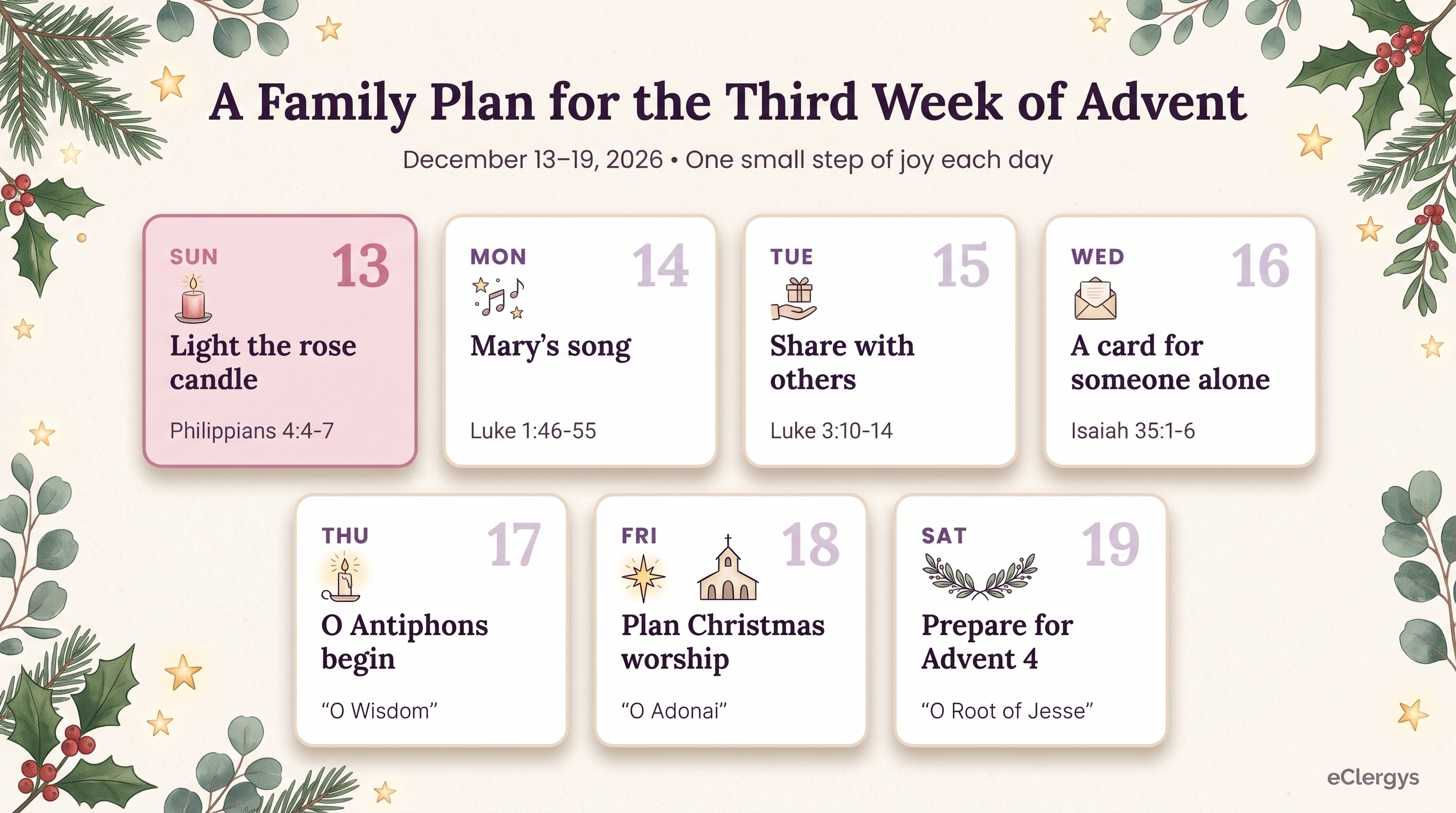
A simple plan for the third week of Advent 2026
|
Day |
Date |
Idea |
|
Sunday |
Dec 13 |
Light the rose candle; read Philippians 4:4–7; bring the Christ Child figure for blessing if your parish offers it |
|
Monday |
Dec 14 |
Read Luke 1:46–55 (Mary's song). Each person names one thing God has done for them this year |
|
Tuesday |
Dec 15 |
Read Luke 3:10–14. Choose clothes or food to give away |
|
Wednesday |
Dec 16 |
Read Isaiah 35:1–6. Write or draw a card for someone who is sick or alone |
|
Thursday |
Dec 17 |
The O Antiphons begin: pray the first one ("O Wisdom") or sing the matching verse of "O Come, O Come, Emmanuel" |
|
Friday |
Dec 18 |
Second O Antiphon ("O Lord / Adonai"). Plan how your family will attend Christmas services |
|
Saturday |
Dec 19 |
Third O Antiphon ("O Root of Jesse"). Prepare for the Fourth Sunday of Advent |
Catholic families can also use this week for confession before Christmas and for the Joyful Mysteries of the Rosary, which focus on the events surrounding Jesus' birth.
How the Third Sunday Differs From the Other Advent Sundays
|
Sunday |
Main focus of the readings |
Candle |
Common theme in many churches |
|
First Sunday |
Stay awake; be ready for Christ's return |
Violet |
Hope |
|
Second Sunday |
John the Baptist calls people to repent and "prepare the way" |
Violet |
Peace |
|
Third Sunday (Gaudete) |
Rejoice: the Lord is near; John points to the One who is coming |
Rose |
Joy |
|
Fourth Sunday |
The events just before Jesus' birth, often featuring Mary and Joseph |
Violet |
Love |
The third Sunday is the only Sunday of Advent with its own color and its own traditional name. It marks the point where the season's mood moves from "get ready" toward "he is almost here."
Common Misunderstandings About Gaudete Sunday
"Gaudete Sunday means Advent's preparation is over." Not quite. The joy of the third Sunday is a pause and an encouragement, not the end of Advent. The violet candle returns on the fourth Sunday, and the season continues until Christmas Eve.
"Rose vestments are required." In the Catholic Church, rose is optional. A priest wearing violet on Gaudete Sunday is following the rules, especially if the parish does not have rose vestments.
"The pink candle stands for Mary." Some families and devotional guides connect the candles with Mary, shepherds, or angels. These are popular customs. The liturgical reason for the rose candle is the joy of Gaudete Sunday.
"Every church uses a pink candle." Many churches use four blue or four violet candles, and Orthodox Christians do not keep Gaudete Sunday at all. Different practices are not mistakes; they reflect different traditions.
"It's just a pink day." Clergy are often quick to point out that the color is rose, a lightened violet. The name matters because it shows the connection: the same season, brightened by joy.
The Message of Hope, Faith, and Joy Before Christmas
The third week of Advent sits between waiting and arrival. Hope began the season. Faith keeps it going when Christmas still seems far away. Joy breaks through in the middle, like the first light before sunrise, because the One we are waiting for is already close.
Gaudete Sunday does not ask Christians to ignore the darkness of the world. It asks them to remember where the light is coming from. As Paul wrote from his prison cell, "Rejoice in the Lord always… The Lord is near." That is the message of the rose candle, the rose vestments, and the whole third week of Advent: the waiting is real, but so is the promise, and the promise is about to be fulfilled.
Frequently Asked Questions About the Third Week of Advent
What is the third week of Advent called?
The third week of Advent begins with Gaudete Sunday. Gaudete is Latin for "rejoice," taken from the opening words of the Mass for that day (Philippians 4:4–5). The week is often called the week of joy.
When is Gaudete Sunday in 2026?
Gaudete Sunday is on December 13, 2026. The third week of Advent runs from December 13 to December 19, 2026, and the Fourth Sunday of Advent follows on December 20.
Why is the third Advent candle pink?
The third candle is rose (pink) because rose is the liturgical color of joy used on Gaudete Sunday. It matches the rose vestments clergy may wear that day and marks the midpoint of Advent, when Christmas is near.
What does the third Advent candle represent?
The third Advent candle represents joy. In many Protestant churches it is also called the Shepherd's Candle, recalling the shepherds who heard the angel announce "good news of great joy" (Luke 2:10).
Why do priests wear pink on the third Sunday of Advent?
Priests may wear rose vestments on Gaudete Sunday to show joy halfway through the penitential season of Advent. Rose is a lighter form of violet. It is optional; if a parish has no rose vestments, violet is used.
How many times a year are rose vestments worn?
Rose vestments may be worn on two days a year: Gaudete Sunday (the Third Sunday of Advent) and Laetare Sunday (the Fourth Sunday of Lent). Both names mean "rejoice."
How do you pronounce Gaudete?
Gaudete is usually pronounced "gow-DAY-tay" in Church Latin. The first syllable rhymes with "now."
Do Protestants celebrate Gaudete Sunday?
Many do. Anglican, Episcopal, and Lutheran churches often know the day as Gaudete Sunday, and many Methodist and other Protestant churches light a joy candle on the third Sunday of Advent. Some use blue candles and vestments instead of rose. Eastern Orthodox churches do not observe Gaudete Sunday.