
Fourth Week of Advent 2026— Meaning, the Candle of Love, Bible Verses, and Preparing for Christmas
By the fourth Sunday of Advent, the waiting is almost over. Three candles on the wreath have already burned for weeks. Nativity scenes are set up, and Christmas services are only days away. Then the readings change their focus. They stop looking at prophets in the desert and start looking at a young woman in Nazareth, a carpenter wrestling with a hard decision, and an angel bringing news that would change the world.
This is the fourth week of Advent: the shortest, most crowded, and in many ways the most tender part of the season.
In this guide, you'll find clear answers to the questions people ask most:
- When does the fourth week of Advent begin and end in 2026?
- What does the fourth Advent candle represent, and why is it called the Angel's Candle?
- Is the Fourth Sunday of Advent the same as Christmas Eve?
- Which Bible verses and readings belong to the fourth week?
- How can pastors and churches prepare for Christmas services?
Quick Answer
The fourth week of Advent is the final part of the Advent season. It begins on the Fourth Sunday of Advent and ends on Christmas Eve. Its Bible readings focus on the events just before Jesus' birth: the angel Gabriel's message to Mary, Joseph's dream, and God's promise to King David. In many churches the fourth candle on the Advent wreath is called the Candle of Love or the Angel's Candle, though some traditions link it to peace. In 2026, the Fourth Sunday of Advent falls on December 20, and the fourth week runs from December 20 to December 24.
When Does the Fourth Week of Advent Begin in 2026?
In 2026, the fourth week of Advent begins on Sunday, December 20 and ends on Thursday, December 24, Christmas Eve. Christmas Day falls on Friday, December 25. That makes the fourth week only five days long this year.
Why the fourth week changes length every year
Advent always has four Sundays, but it does not always have four full weeks. Advent begins on the fourth Sunday before Christmas, so the length of the last week depends on which day of the week Christmas falls. The Fourth Sunday of Advent can come as early as December 18 or as late as December 24.
When Christmas falls on a Sunday, the fourth week is a full seven days. When Christmas falls on a Monday, the Fourth Sunday of Advent is Christmas Eve itself, and the fourth "week" lasts only part of a day. That last happened in 2023 and will happen again in 2028.
| 2026 | 2027 | 2028 | |
|---|---|---|---|
| Fourth Sunday of Advent | Sunday, Dec 20 | Sunday, Dec 19 | Sunday, Dec 24 |
| Fourth week of Advent | Dec 20–24 (5 days) | Dec 19–24 (6 days) | Dec 24 only (part of one day) |
| Christmas Day | Friday, Dec 25 | Saturday, Dec 25 | Monday, Dec 25 |
| Catholic Lectionary year | Year B | Year C | Year A |
Fourth Sunday of Advent dates, 2022–2030
| Year | Fourth Sunday of Advent | Length of the fourth week | Reading cycle |
|---|---|---|---|
| 2022 | Sunday, December 18 | 7 days | Year A |
| 2023 | Sunday, December 24 | 1 day | Year B |
| 2024 | Sunday, December 22 | 3 days | Year C |
| 2025 | Sunday, December 21 | 4 days | Year A |
| 2026 | Sunday, December 20 | 5 days | Year B |
| 2027 | Sunday, December 19 | 6 days | Year C |
| 2028 | Sunday, December 24 | 1 day | Year A |
| 2029 | Sunday, December 23 | 2 days | Year B |
| 2030 | Sunday, December 22 | 3 days | Year C |
Is the Fourth Sunday of Advent the same as Christmas Eve?
Usually not. The two fall on the same day only when December 24 is a Sunday, as in 2023 and 2028. In 2026, they are four days apart.
When they do overlap, Catholic dioceses in the United States treat them as two separate celebrations. Morning and early afternoon Masses on December 24 are for the Fourth Sunday of Advent, and evening Masses are Christmas Vigil Masses. The Sunday obligation and the Christmas obligation are separate, so one Mass does not fulfill both. Many Protestant churches handle that day by holding a morning Advent service and a Christmas Eve service in the evening.
What Does the Fourth Week of Advent Represent?
The fourth week of Advent represents the final stage of preparation for Christ's birth. The first Sundays of Advent look toward Christ's second coming and call people to wake up and repent. The fourth Sunday turns the spotlight fully on the first Christmas.
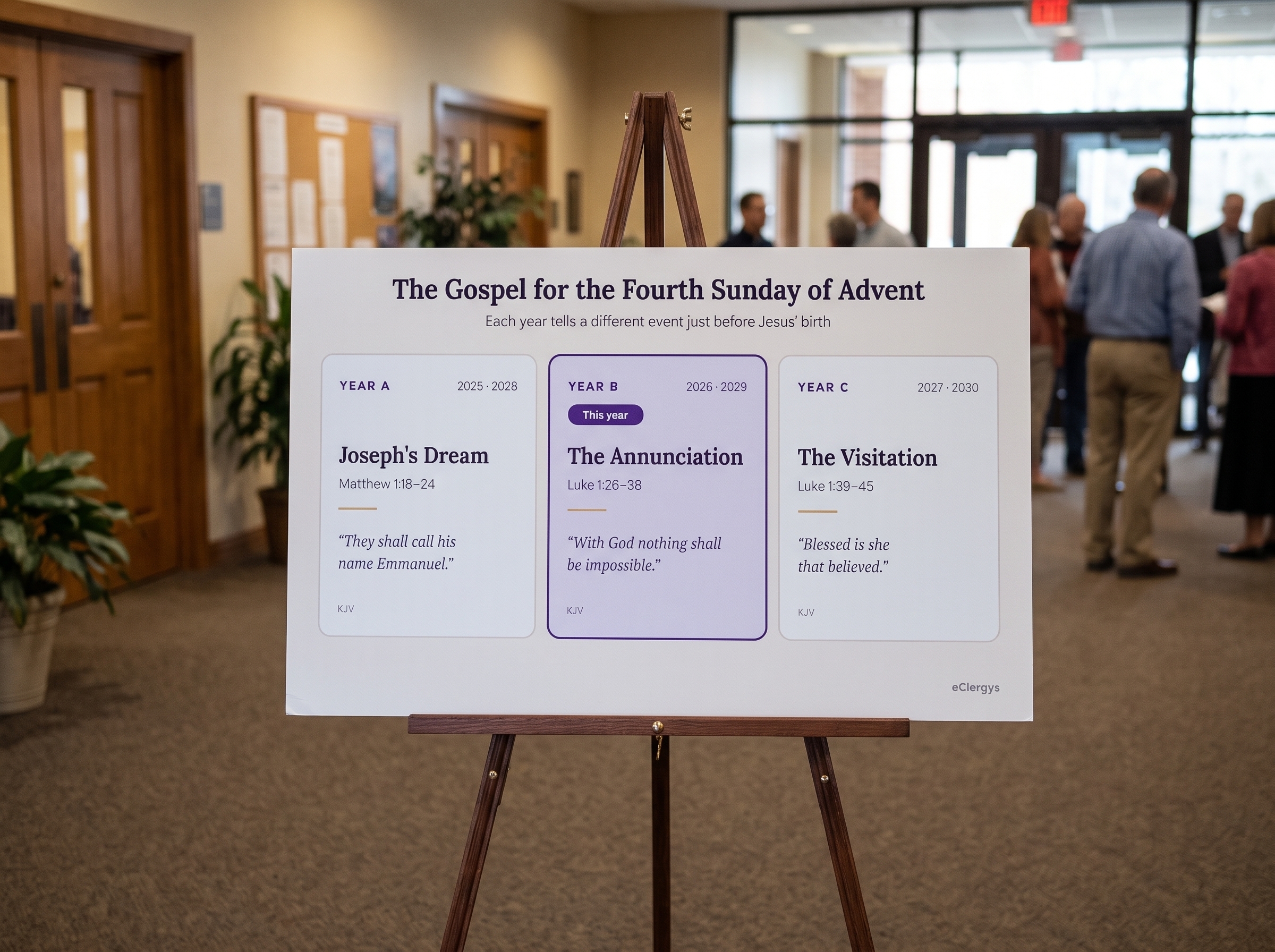
In Catholic and many Protestant churches, the readings move from John the Baptist to Mary, the mother of Jesus, and to Joseph. The Gospel on this Sunday always tells one of the events that happened just before Jesus was born:
- Year A: an angel tells Joseph in a dream to take Mary as his wife (Matthew 1:18–24).
- Year B (2026): the angel Gabriel announces to Mary that she will bear the Son of God (Luke 1:26–38), an event called the Annunciation.
- Year C: Mary visits her relative Elizabeth, who calls her blessed (Luke 1:39–45), an event called the Visitation.
The week also carries a strong theme of God keeping His promises. In 2026, the first reading is 2 Samuel 7, where God promises King David that his kingdom will last forever. In the Gospel, the angel tells Mary that her son will receive "the throne of his father David" (Luke 1:32). A promise made about a thousand years earlier is about to be fulfilled in a small house in Nazareth.
The liturgical color stays violet (purple). Unlike the third Sunday, there is no rose. Many churches keep the Advent mood of watchful waiting until Christmas Eve, then switch to white or gold for Christmas.
The "late Advent" days: December 17–24
In the Catholic calendar, the weekdays from December 17 to December 24 are set apart for more direct preparation for Christmas. During these days the Church prays the O Antiphons, seven ancient prayers that call on Christ by titles from the prophet Isaiah. In 2026, four of the seven fall during the fourth week, and the fourth antiphon, O Key of David, falls on the Fourth Sunday of Advent itself. (See the prayer section below for the full list.)
What Does the Fourth Advent Candle Represent?
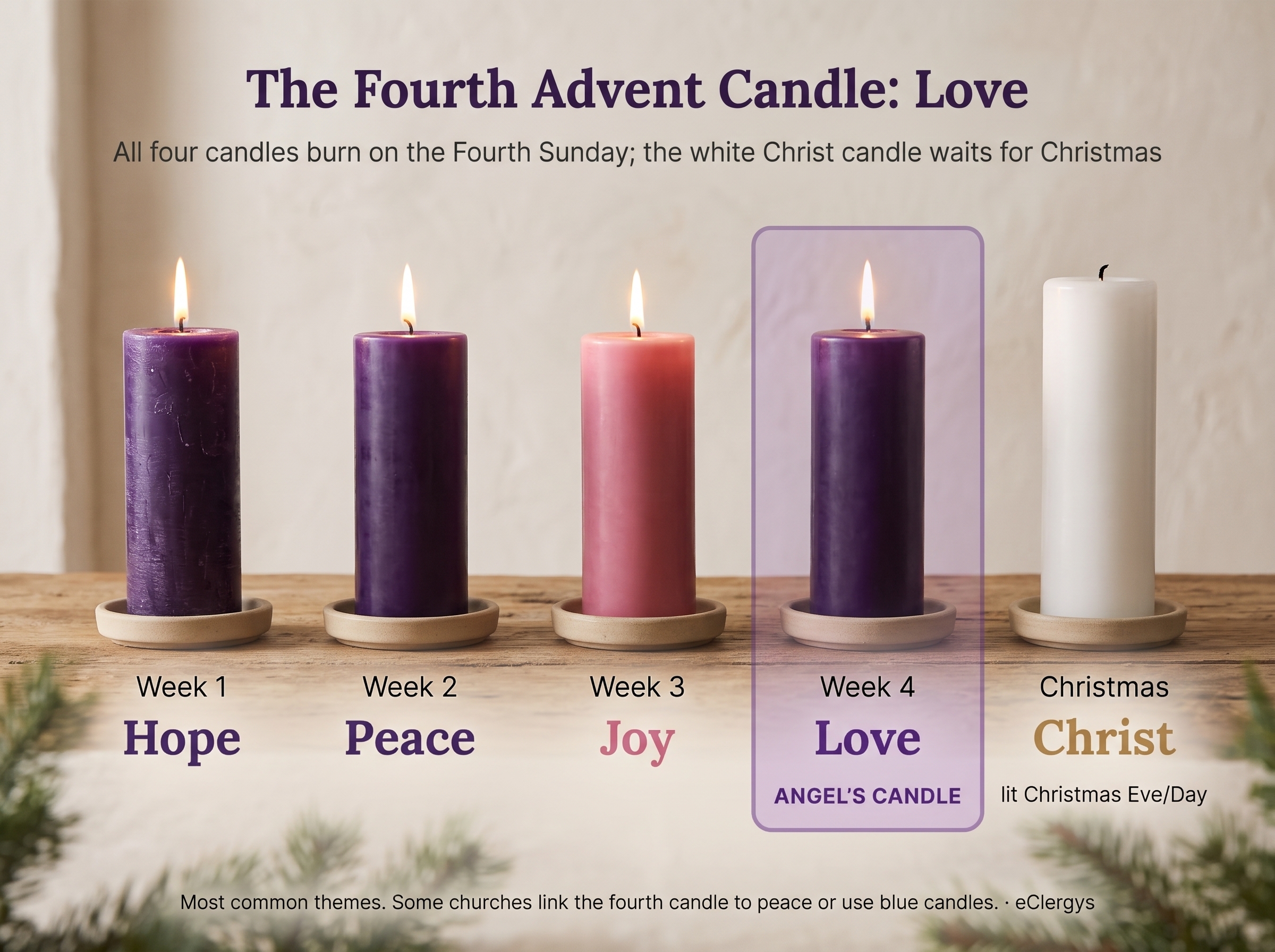
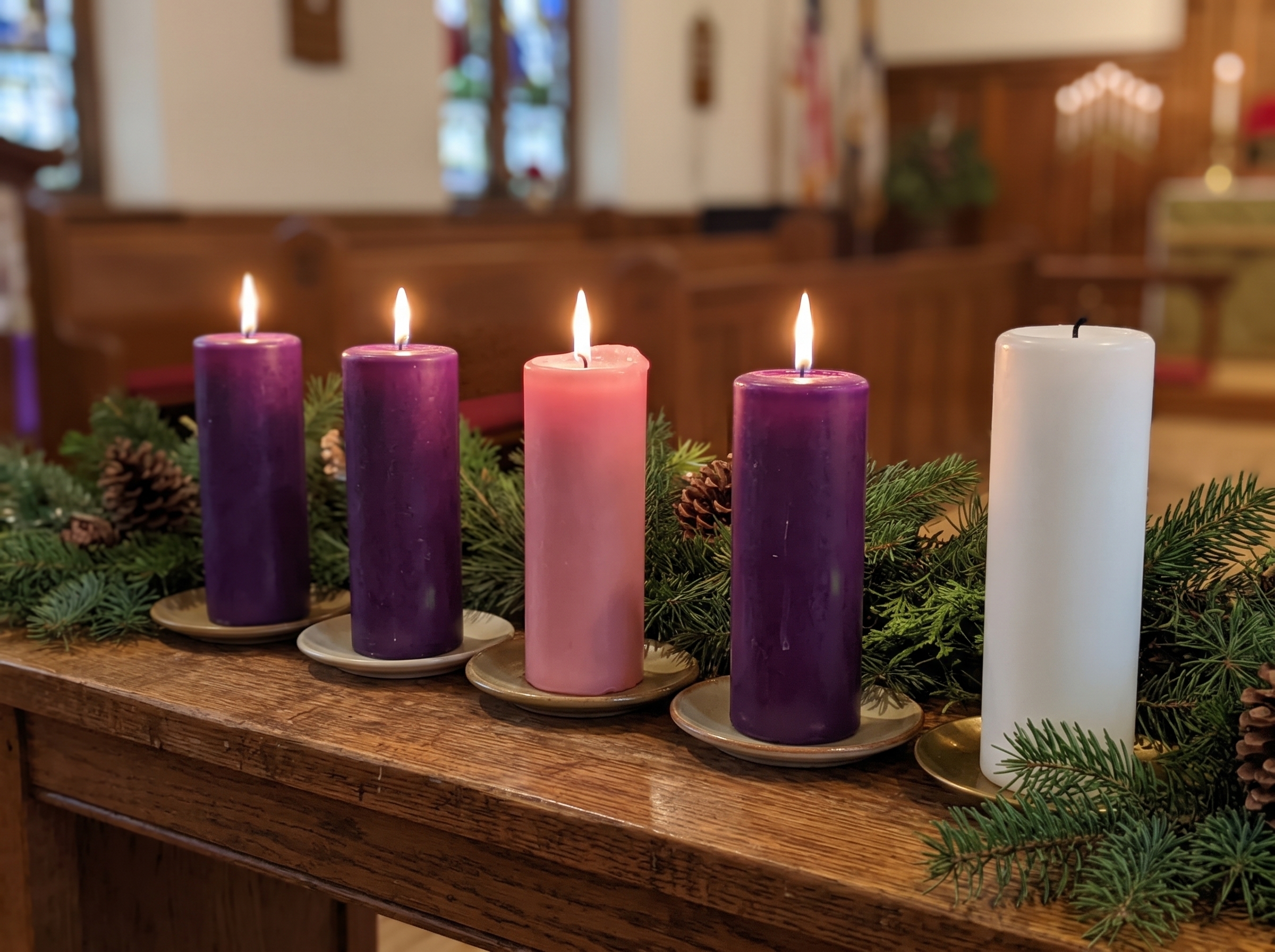
In most churches and homes today, the fourth Advent candle represents love: God's love revealed in sending His Son into the world. It is commonly called the Angel's Candle, remembering the angels who announced Christ's coming to Mary, to Joseph, and to the shepherds. On the fourth Sunday, all four candles on the wreath are lit together.
What color is the fourth Advent candle?
In Catholic and many Protestant wreaths, the fourth candle is purple or violet, like the first two. Only the third candle is rose (pink). Some Lutheran, Methodist, and other Protestant churches use blue candles for Advent instead, so their fourth candle is blue.
Why do some sources say the fourth candle means peace?
Candle names and themes are devotional customs, not fixed church law, and they vary between churches and publishers. The most common modern order is hope, peace, joy, love. However, some parishes and older devotional guides use a different order and link the fourth candle to peace, often pointing to the angels' song in Luke 2:14. The United Methodist Church's early Advent materials, for example, used the order hope, love, joy, peace. Both choices point to the same Christmas message, so a church should simply follow its own tradition.
| Week | Most common theme | Common candle name | Usual color (Catholic / many Protestant) |
|---|---|---|---|
| First Sunday | Hope | Prophecy Candle | Violet |
| Second Sunday | Peace | Bethlehem Candle | Violet |
| Third Sunday | Joy | Shepherd's Candle | Rose |
| Fourth Sunday | Love (sometimes peace) | Angel's Candle | Violet |
| Christmas Eve / Day | Christ, the Light of the World | Christ Candle | White |
What is the Christ candle?
Many churches and families place a large white candle in the center of the wreath. It is called the Christ candle and is lit on Christmas Eve or Christmas Day to celebrate that the Light of the World has come. It is not lit during the fourth week of Advent.
Why Is Love Associated With the Fourth Week of Advent?
Love is linked to the fourth week because this is the week Christians remember how God chose to come: not as a distant ruler, but as a baby born to a young mother. The Bible describes this choice as an act of love. "For God so loved the world, that he gave his only begotten Son" (John 3:16, KJV). The apostle John says the same thing another way: "In this was manifested the love of God toward us, because that God sent his only begotten Son into the world, that we might live through him" (1 John 4:9, KJV).
The theme of love is a devotional emphasis. Official liturgical books do not name the fourth Sunday "Love Sunday". But the readings make the theme easy to see, because each Gospel for this Sunday shows love in action:
- Mary's trust. Mary says yes to God's plan even though it will cost her a great deal: "Behold the handmaid of the Lord; be it unto me according to thy word" (Luke 1:38, KJV).
- Joseph's faithfulness. Joseph could have quietly ended his engagement. Instead, he protects Mary and gives the child a name and a family (Matthew 1:24–25).
- Elizabeth's welcome. When Mary arrives, Elizabeth greets her with joy and blessing instead of suspicion (Luke 1:42).
Christian love, in this week, is more than a warm feeling. It is trust, faithfulness, and welcome. John draws the practical conclusion: "Beloved, if God so loved us, we ought also to love one another" (1 John 4:11, KJV).
Bible Readings for the Fourth Sunday of Advent
Catholic Sunday readings follow a three-year cycle. Many Episcopal, Lutheran, Methodist, and Presbyterian churches use the Revised Common Lectionary (RCL), which follows the same pattern with small differences in verses.
| Lectionary year | Years | First Reading | Psalm | Second Reading | Gospel |
|---|---|---|---|---|---|
| Year A | 2025, 2028 | Isaiah 7:10–14 | Psalm 24 | Romans 1:1–7 | Matthew 1:18–24 |
| Year B | 2026, 2029 | 2 Samuel 7:1–5, 8b–12, 14a, 16 | Psalm 89 | Romans 16:25–27 | Luke 1:26–38 |
| Year C | 2027, 2030 | Micah 5:1–4a | Psalm 80 | Hebrews 10:5–10 | Luke 1:39–45 |
Catholic Lectionary for Mass (USA). In the RCL, the 2026 first reading is 2 Samuel 7:1–11, 16, and the psalm may be replaced by Mary's song, the Magnificat (Luke 1:46b–55). Micah 5:1 in Catholic Bibles is Micah 5:2 in the KJV.
In 2026 (Year B), the readings form one clear line. God promises David a lasting kingdom (2 Samuel 7). Paul praises God for revealing a mystery "kept secret since the world began" (Romans 16:25, KJV). And in Luke, Gabriel tells Mary that her son will sit on David's throne. The promise and the fulfillment sit side by side.
Important Bible Verses for the Fourth Week of Advent (KJV)
The passages below are quoted from the King James Version. Each one connects the fourth week to God's love, Christ's coming, or the preparation for Christmas.
Luke 1:26–38 — The Annunciation
“And the angel said unto her, Fear not, Mary: for thou hast found favour with God. And, behold, thou shalt conceive in thy womb, and bring forth a son, and shalt call his name JESUS.” (Luke 1:30–31)
“For with God nothing shall be impossible.” (Luke 1:37)
This is the Gospel for the Fourth Sunday of Advent in 2026. It shows God's plan beginning in an ordinary home in Nazareth, and Mary's free answer of faith. For Advent, it teaches that preparing for Christ means making room for God's will, even when the way forward is unclear.
Luke 1:39–45 — The Visitation
“And blessed is she that believed: for there shall be a performance of those things which were told her from the Lord.” (Luke 1:45)
Mary travels to visit Elizabeth, and Elizabeth's unborn son, John the Baptist, leaps for joy. This passage links the Advent figures together: John, who prepared the way in earlier weeks, now greets Christ before either is born. It praises Mary above all for believing God's word.
Matthew 1:18–25 — Joseph's Dream
“Behold, a virgin shall be with child, and shall bring forth a son, and they shall call his name Emmanuel, which being interpreted is, God with us.” (Matthew 1:23)
Matthew tells the story from Joseph's side. An angel tells him not to be afraid to take Mary as his wife, and that the child "shall save his people from their sins" (Matthew 1:21). The name Emmanuel, "God with us," sums up the whole meaning of Christmas.
Isaiah 7:14 and Micah 5:2 — The Promises Behind Christmas
“Therefore the Lord himself shall give you a sign; Behold, a virgin shall conceive, and bear a son, and shall call his name Immanuel.” (Isaiah 7:14)
“But thou, Bethlehem Ephratah, though thou be little among the thousands of Judah, yet out of thee shall he come forth unto me that is to be ruler in Israel.” (Micah 5:2)
Christians read these prophecies as promises fulfilled in Jesus: born of the Virgin Mary, in the small town of Bethlehem. They are read on the Fourth Sunday of Advent in Years A and C.
John 3:16 — The Reason for the Gift
“For God so loved the world, that he gave his only begotten Son, that whosoever believeth in him should not perish, but have everlasting life.”
This verse explains why Christmas happened. The birth at Bethlehem is the beginning of God's gift of salvation, which is why it fits the candle of love so well.
1 John 4:7–12 — Love Made Visible
“Beloved, let us love one another: for love is of God; and every one that loveth is born of God, and knoweth God.” (1 John 4:7)
“Herein is love, not that we loved God, but that he loved us, and sent his Son to be the propitiation for our sins.” (1 John 4:10)
John teaches that God's love comes first and ours is a response. During the fourth week, this passage turns reflection into action: the love we celebrate at Christmas should be visible in how we treat others.
Luke 2:1–20 — The Nativity
“And she brought forth her firstborn son, and wrapped him in swaddling clothes, and laid him in a manger; because there was no room for them in the inn.” (Luke 2:7)
“Glory to God in the highest, and on earth peace, good will toward men.” (Luke 2:14)
This is the Christmas story itself, usually read on Christmas Eve rather than during Advent. Families often read it at the end of the fourth week as the bridge from waiting to celebration.
How Churches Celebrate the Fourth Week of Advent
The fourth week is observed differently across Christian traditions. The table shows common practices; local customs always vary.
| Tradition | What the fourth week looks like |
|---|---|
| Roman Catholic | Violet vestments; readings focused on Mary and Joseph; O Antiphons Dec 17–23; Advent wreath with all four candles lit; many parishes offer confession before Christmas; Christmas Vigil Masses begin on the evening of Dec 24 |
| Episcopal / Anglican | RCL readings; Mary's song (Magnificat) often sung; many parishes hold a Service of Lessons and Carols in late December |
| Lutheran | RCL readings; the traditional Advent prayer begins "Stir up your power, O Lord, and come"; blue or violet paraments |
| Methodist and other Protestant | The fourth (love) candle is lit; children's pageants and Christmas programs; Christmas Eve candlelight services where the Christ candle is lit |
| Hispanic Catholic communities (US) | Las Posadas, Dec 16–24: nightly processions reenacting Mary and Joseph's search for shelter in Bethlehem |
| Filipino Catholic communities (US) | Simbang Gabi, Dec 16–24: a nine-day novena of Masses before Christmas, often held in the evening in the US |
| Eastern Orthodox | No Advent wreath traditionally; the 40-day Nativity Fast continues; the Sunday before the Nativity (Dec 18–24) honors Christ's ancestors and reads His genealogy (Matthew 1:1–25) |
Las Posadas and Simbang Gabi both show the theme of the week in a vivid way. One acts out the search for room at the inn; the other gathers the community night after night to wait for Christ together.
Advent Prayers and Reflections for the Fourth Week
A prayer for lighting the fourth candle
Loving God, as we light this fourth candle, we remember the love that sent your Son into the world. Give us Mary's trust, Joseph's faithfulness, and Elizabeth's joyful welcome. Make room in our hearts and homes for Jesus, Emmanuel, God with us. Amen.
The O Antiphons in 2026
The O Antiphons are seven short prayers sung at Evening Prayer from December 17 to 23, and used as the Gospel verse at Mass on those days. Each one calls on Christ by a title drawn mainly from the prophet Isaiah. Many people know them through the hymn "O Come, O Come, Emmanuel." Read backward, the first letters of the Latin titles spell ERO CRAS, often translated "Tomorrow I will come."
| Date (2026) | Antiphon | Title of Christ |
|---|---|---|
| Thu, Dec 17 | O Sapientia | O Wisdom |
| Fri, Dec 18 | O Adonai | O Lord |
| Sat, Dec 19 | O Radix Jesse | O Root of Jesse |
| Sun, Dec 20 (Fourth Sunday of Advent) | O Clavis David | O Key of David |
| Mon, Dec 21 | O Oriens | O Dayspring / Radiant Dawn |
| Tue, Dec 22 | O Rex Gentium | O King of the Nations |
| Wed, Dec 23 | O Emmanuel | O God with Us |
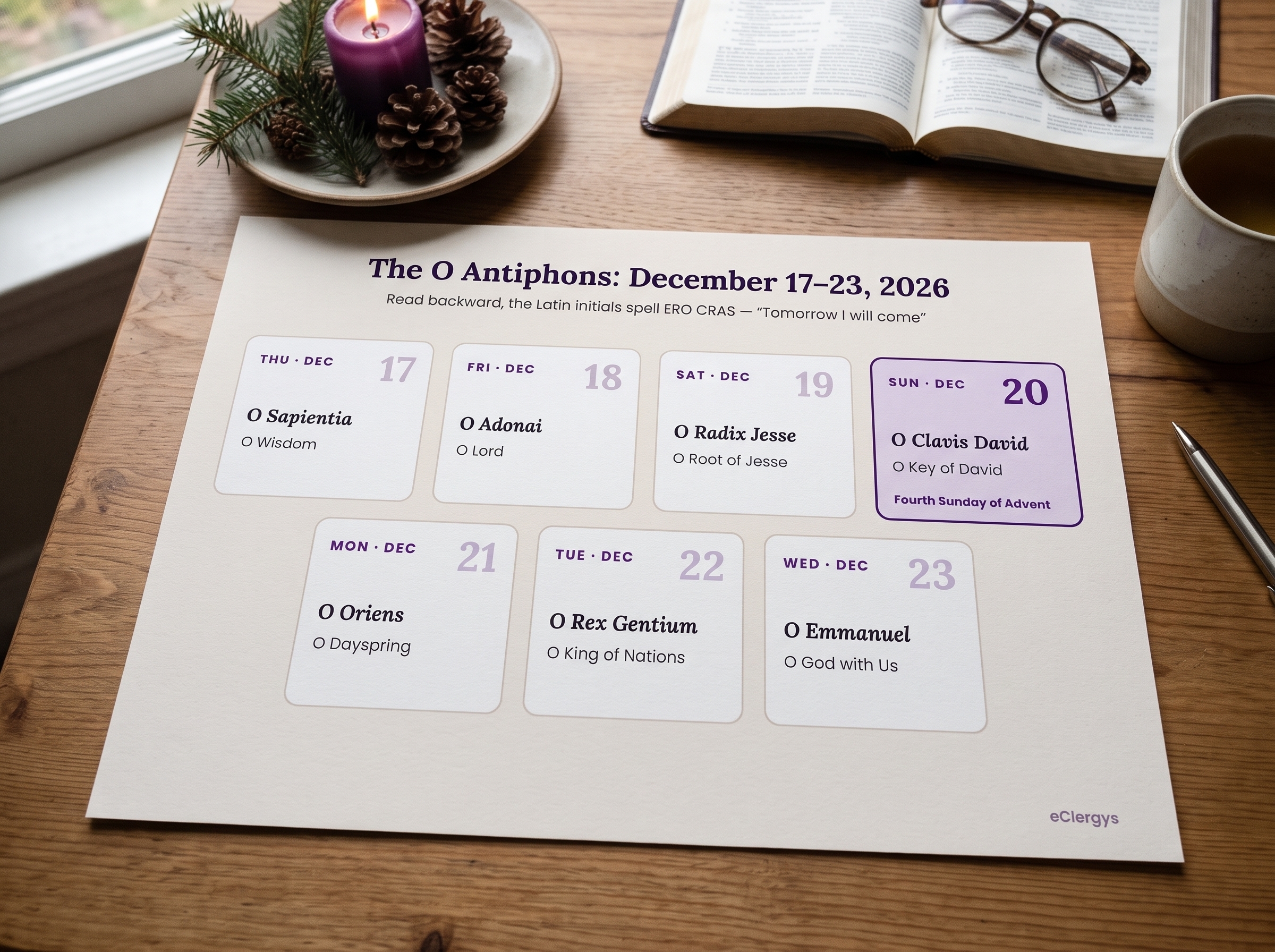
A simple family practice: each evening, light the wreath and sing the matching verse of "O Come, O Come, Emmanuel."
Questions for reflection
- Where is God asking me to say "be it unto me according to thy word" this Christmas?
- Like Joseph, is there a hard but faithful choice I need to make?
- Who in my life needs the kind of welcome Elizabeth gave Mary?
A prayer for pastors and clergy
Lord Jesus, in these last busy days before Christmas, keep my heart quiet enough to hear your word. Let my preaching point to your love, my service reflect your humility, and my care reach those who find this season hard. Amen.
Preparing Your Church and Congregation for Christmas
For pastors, priests, and church staff, the fourth week of Advent is the busiest stretch of the year. In 2026 it is also short: the Fourth Sunday is December 20, and Christmas Eve services begin just four days later. A little planning keeps the final days of Advent prayerful instead of rushed.
Keep Advent until Advent ends
It is tempting to switch to Christmas early. But the fourth Sunday still belongs to Advent, so the liturgical color remains violet, and its readings deserve their own focus on Mary, Joseph, and God's promises. Many churches schedule the "turnover" of the sanctuary to Christmas decorations for the last day or two before Christmas Eve. In 2026, that leaves Tuesday through Thursday for the work.
Announce the Christmas schedule on the Fourth Sunday
The Fourth Sunday of Advent is often the last time many members are in church before Christmas. Use it to announce Christmas Eve and Christmas Day service times, confession or reconciliation times, and any Las Posadas, Simbang Gabi, or Lessons and Carols events. In years like 2028, when the Fourth Sunday falls on Christmas Eve, explain clearly which services are for Advent and which are for Christmas.
Prepare vestments and church garments
The change from Advent to Christmas is also a change of color, from violet to white or gold in most liturgical churches. Check Christmas vestments and stoles a week or two early for wrinkles, stains, or loose trim. White albs and surplices show every mark, so plan time for washing and pressing; our guide on how to clean white priest albs covers the basics. Don't forget the altar servers and choir, who are often the most visible people at Christmas services.
Clergy attire for Christmas services
Christmas Eve and Christmas Day draw some of the largest congregations of the year, including visitors and families who rarely attend. Well-fitting, clean clergy attire helps the focus stay on worship rather than on the minister. Depending on your tradition, these are the garments most churches review before Christmas:
- Vestments and stoles: white or gold clergy vestments and stoles and tippets for the change from Advent to Christmas.
- Robes and cassocks: clergy robes for men, clergy robes for women, and cassocks.
- Albs and surplices: clergy albs and surplices, which show every mark under Christmas lighting.
- Clergy shirts: men's clergy shirts and women's clergy shirts for less formal services and pastoral visits.
- Altar servers: altar server cassocks, albs, and cottas.
One practical note: garments ordered during the fourth week of Advent will not arrive in time for Christmas. At eClergys, standard orders typically take two to three weeks and made-to-measure garments three to four weeks, so Christmas garments are best planned in early November. If you notice during Christmas services that something needs replacing, write it down and order with plenty of time for Epiphany, Lent, or Easter.
Care for those who find Christmas hard
Not everyone arrives at the fourth week full of joy. Grief, loneliness, illness, and money worries can feel heavier in December. Many churches hold a quiet "Blue Christmas" or "Longest Night" service near December 21, the longest night of the year. A short visit, a phone call, or a personal invitation to Christmas worship can be the most loving act of the whole season.
The Fourth Week in the Journey of Advent
Each Sunday of Advent builds on the one before. The First Sunday of Advent opens the season with hope and watchfulness. The Second Sunday of Advent brings John the Baptist's call to prepare the way. The Third Sunday, Gaudete Sunday, breaks into joy because the Lord is near. The fourth week completes the journey by showing how close He has come: into Mary's life, Joseph's home, and the line of King David.
Frequently Asked Questions (FAQs)
What is the fourth week of Advent?
The fourth week of Advent is the last part of the Advent season, from the Fourth Sunday of Advent until Christmas Eve. Its readings focus on the events just before Jesus' birth, including the angel Gabriel's message to Mary and Joseph's dream. Many churches associate it with love.
When is the Fourth Sunday of Advent in 2026?
The Fourth Sunday of Advent is on Sunday, December 20, 2026. The fourth week runs from December 20 to Thursday, December 24 (Christmas Eve), and Christmas Day is Friday, December 25.
What does the fourth Advent candle represent?
The fourth Advent candle most often represents love: God's love shown in sending His Son. It is commonly called the Angel's Candle. Some churches link it to peace instead, because candle themes vary by tradition.
What color is the fourth Advent candle?
In Catholic and many Protestant Advent wreaths, the fourth candle is purple or violet. Only the third candle is rose (pink). Churches that use blue for Advent have a blue fourth candle.
Is the Fourth Sunday of Advent the same as Christmas Eve?
Only when December 24 falls on a Sunday, as in 2023 and 2028. In 2026, the Fourth Sunday is December 20 and Christmas Eve is Thursday, December 24. When the two fall on the same day, Catholic churches celebrate the Fourth Sunday in the morning and Christmas Vigil Masses in the evening.
What is the Gospel for the Fourth Sunday of Advent?
It changes in a three-year cycle: Matthew 1:18–24 (Joseph's dream) in Year A, Luke 1:26–38 (the Annunciation) in Year B, and Luke 1:39–45 (the Visitation) in Year C. In 2026, Year B, the Gospel is Luke 1:26–38.
When do you light the Christ candle?
The white Christ candle in the center of the Advent wreath is lit on Christmas Eve or Christmas Day, not during the fourth week of Advent. It celebrates Jesus, the Light of the World, after the four Advent candles have prepared the way.
Conclusion
The fourth week of Advent is short, and in some years it barely exists. Yet it carries the heart of the whole season. Hope, peace, and joy all lead here, to the moment when God's promise becomes a person. Mary's trust, Joseph's faithfulness, and Elizabeth's welcome show what it looks like to receive that love.
As the fourth candle burns beside the other three, the light is almost complete. One more candle remains: the Christ candle of Christmas. Until it is lit, the fourth week invites every Christian to make room — in the heart, the home, and the church — for Emmanuel, God with us.
Dress your church for Christmas
From white and gold vestments to fresh albs and altar server attire, eClergys makes clergy garments to your measure for every season of the Church year.
Shop Clergy Vestments